Tuesday, October 2, 2012

Day 23/60: The High Line, MoMA

Monday, 10/1: New York City

After two long and intense days, we gave ourselves a late start today. We got up around 5 a.m., but we lolled around the room working with our writing and photos. Then I needed to make a run to a drug store.

The whole process of getting into Manhattan—shuttle to subway station, subway to Times Square, then catching a cab downtown—must have taken an hour, so it was about 1 p.m. by the time we got to Gansevoort Street, at the bottom of the High Line Park. As we disembarked, the driver, knowing we planned to walk through the park, said, "If you want to get lunch first, Pastis is just a few blocks down."

We had been thinking of having a perfunctory lunch before hitting the trail, but Pastis turned out to be an authentic Parisian bistro. Well, there was no smoking, so I suppose the ceiling was painted nicotine yellow instead of acquiring that hue naturally, but seriously, the menu, the seating, the service, and especially the food was FRENCH, praise the lord. I love French food. Yes, it was expensive. The special for the day, sole meuniere, was $42. We settled for the sea bass in a lobster sauce with nuggets of lobster over a bed of spinach for $26. For my taste, it doesn't get much better than this. Because of our impending walk, we stuck to ice tea.

Pastis Bistro
Dan's photo
So it was 2:30 by the time we got upstairs to the elevated bed of a disused railway, the High Line, which has been transformed into a park. What a brilliant move. You can walk about twenty blocks across town without traffic. Rangy wildflowers grow between the rails. Benches are strategically located for appreciating the fascinating views. There are vendors of popsicles and such in a few places, but it is not cluttered up with commerce, or beggars. It took us about 45 minutes to walk the length, with photo stops. Oh yes, the weather was perfect—sunny, breezy, about 72 degrees.

View from the High Line Park
Dan's photo
Maximum foliage on the High Line Park
Dan's Photo
Soon after we descended to street level we were able to hail a taxi, and we were at the Museum of Modern Art by 3:35. Dan charged straight up to the fifth floor and started snapping, but I required an infusion of caffeine and sugar before I could go on so I spent about 45 precious minutes getting an iced latte and chocolate cookie from their cafe. Once I got up to the fifth floor, where the classics of modernism are exhibited, I quickly found Dan. We had about an hour and a half before the museum closed. We agreed to meet in the gift shop, which stays open a little later.

It would have been a travesty to spend such a short time at one of the country's great museums, except that we have toured it at least four times over the years. The thing that surprised me was how well some of the paintings at MoMA hold up over time. Dan concentrated on documenting some of the most famous images in modern art. I'll present a selection with just one for each painter, but for major artists like van Gogh and Picasso, the museum has several famous works for each.  I got more interested in some works that I hadn't seen before; I'll mix a few of those in, too.

The Bather, c. 1885
by Paul Cézanne (French, 1839-1906)
 Jan's photo

The Starry Night, 1889
Vincent van Gogh (Dutch, 1853-1890)
Dan's photo
The Sleeping Gypsy, 1897
Henri Rousseau (French, 1844-1910)
Dan's photo
Les Demoiselles d'Avignon, 1907
Pablo Picasso (Spanish, 1881-1973)
Dan's photo
Dance I, 1909
Henri Matisse (French, 1869-1954)
Dan's photo
I and the Village, 1911
Marc Chagall (French, born Belarus, 1887-1985)
Dan's photo
Dynamism of a Soccer Player, 1913
Umberto Boccioni (Italian, 1882-1916)
Dan's photo
Three Women,  1922
Fernand Léger (French, 1881-1955)
Dan's photo
Figure, 1921
Varvara Stepanova (Russian, 1894-1958)
Jan's photo
Dr. Mayer-Hermann, 1926
Otto Dix (German, 1891-1969)
Dan's photo
Kenneth Fearing, 1935
Alice Neel (American, 1900-1984)
Jan's photo
Flag, 1954-55
Jasper Johns (American, born 1930)
Dan's photo
Wood, Wind, No Tuba, 1980
 Joan Mitchell (American, 1925-1992)
Dan's photo

Dan and I found each other when the guards were funneling the crowd out through the doors of the gift store. Then we were standing there on Fifth Avenue parched, wobbly, and overwhelmed. Fifth Avenue  is too ritzy to have cozy little bars and restaurants, so when we came to the Peninsula Hotel, I made a snap decision and marched Dan through the grand lobby and into the luxurious bar. We both had Stella Artois on tap. Dan winced at paying $13 for a beer; I enjoyed the conspicuously tasteful decor and the suave service. A few men in suits were chatting at tables far from us, and the sound system played quietly. We let our minds idle for awhile. Then we used the fancy restrooms. In front of the hotel, the bellman efficiently hailed a cab, and we headed back to our hotel in Queens.

Monday, October 1, 2012

Day 22/60: The Metropolitan MoA

Sunday, 9/30: New York City

Like yesterday, today combined the joy of art with the pleasure of good company. The scene of both was the Metropolitan Museum of Art.

This was our first day to use public transportation to get from our hotel in Queens into Manhattan, and to be frank, the process of climbing the stairs to the train in Queens, transferring to another line at Grand Central Terminal, climbing the stairs back to the street at our destination, walking a half-dozen blocks to the museum, climbing the impressive front steps, buying tickets, and stowing our stuff was strenuous enough to leave us rather puffed. We reacted differently. Setting his teeth with determination, Dan charged into the new American wing, which was our chief objective. I lolled around in the lovely sky-lighted sculpture court until the espresso stand opened at 11:00, then I had a latte.

Cleopatra by William Wetmore Story
Photo by Jan
After that, I quickly caught up with Dan in the American wing. He was urgently absorbed in photographing his old favorites. I followed him around for about an hour.

Then we rushed off to the Petrie Court restaurant, arriving just on time at 12:30; our friends Kelly and Frank were waiting for us. We first met them in 2007 at the Museum of Modern Art when we were sitting near them at a long, shared table in the cafeteria. Our mutual interest in art led to a lively conversation. The next day we ran into them again at The Met, where we were all viewing a special exhibit called "The Clark Brothers Collect." That coincidence caused us to exchange e-mail addresses, and I had been corresponding with them ever since. It was a treat to see them in person; the conversation was wide-ranging and high-quality. The food was exceptional, and they picked up the tab. I was tempted to hang out with them all afternoon, but Dan said, "Come on. We have work to do."

Frank King and Kelly Karavites,
Petrie Court Restaurant, The Met
Photo by Dan L. Smith
The more you know about art, and the more you care, the more you appreciate The Met. It is just astounding that they could have collected so many masterpieces in one place. If you just look at the monetary value alone—assuming you could place a value on priceless artifacts of history—walking through these galleries is like walking through Fort Knox and admiring the piles of bullion.

The American Wing opens with a bang with a monumental patriotic work by Emmanuel Leutze.

Washington Crossing the Delaware, 1851
by Emanuel Leutze (1816-1868)
Dan's photo

When the United States was a newly formed nation on a vast, unexplored continent, landscape became an important subject. Not far behind the explorers and pioneers, landscape artists presented information about faraway places as well as expressing a sort of pride of ownership that counts as patriotism. On top of this, advanced thinkers of the time were looking at nature as a divine force. Artists expressed this idea by creating monumental perspectives with rare and transcendent light effects.

The Beeches, 1845
by Asher B. Durand (1796-1886)
Dan's photo

View from Mount Holyoke, Northhampton, MA after a Thunderstorm-The Oxbow, 1836
by Thomas Cole (1801-1848)
Dan's photo


Heart of the Andes, 1859
by Frederic Edwin Church (1826-1900)
Dan's photo

Similarly, painting served to document typical activities in a spread-out nation before photography became available on a wide scale.

Cider Making, 1840-41
by William Sidney Mount (1807-1868)
Dan's photo

Fur Traders Descending the Missouri, 1845
by George Caleb Bingham (1811-1879)
Dan's photo

Snap the Whip, 1872
by Winslow Homer (1836-1910)
Dan's photo

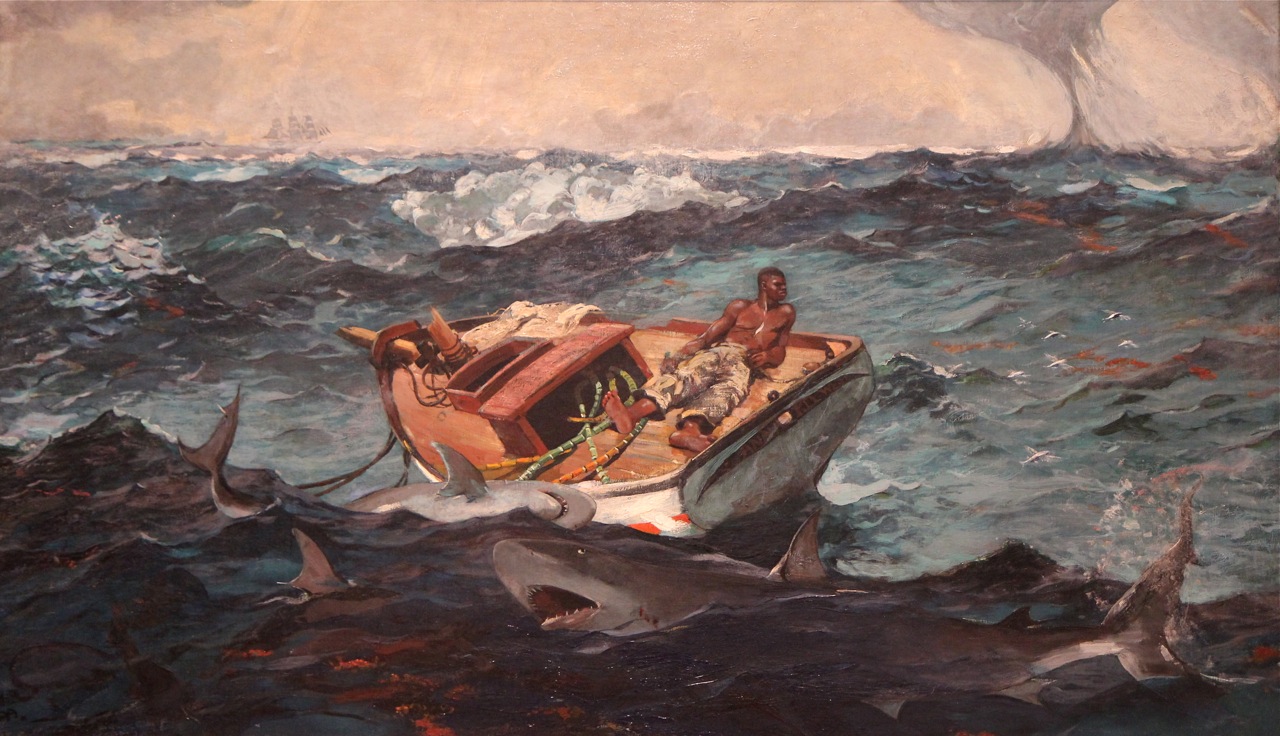
The Gulf Stream, 1899
by Winslow Homer (1836-1910)
Dan's photo


The Champion Single Sculls (Max Schmitt in a Single Scull), 1871
by Thomas Eakins (1844-1916)
Dan's photo

Some of America's greatest talents have felt more comfortable in Europe and spent most of their careers there. Their work is more reflective of European trends. It was particularly difficult for women to achieve stature in the arts or to live a cultivated life in which they freely associated with the most innovative men painters of the time. Mary Cassatt originally went to France during the American Civil War, but she soon induced her family to make their home there. Cassatt's genius was that she could take the soft subjects of women and children in their natural environments and treat them with an intellectual rigor and artistic innovation that won the regard of the severest critics.

Young Mother Sewing, 1900
by Mary Cassatt (1844-1926)
Dan's photo

Another American who felt more at home on the continent was John Singer Sargent. The Met is blessed with a breathtaking collection of his life-size portraits of wealthy and fashionable women. Personally, I'm enchanted by his very loose Impressionist scenes, smaller in scale, which seem to be painted more for his own satisfaction than for a particular clientele.

The Wyndham Sisters: Lady Elcho, Mrs. Adeane, and Mrs. Tennant, 1899
by John Singer Sargent (1856-1925)
Dan's photo


Bringing Down Marble from the Quarries to Carrara, 1911
by John Singer Sargent (1856-1925)
Dan's photo

In the twentieth century, many painters turned their attention to city life.

The Lafayette, 1927
by John Sloan (1871-1951)
Dan's photo

Tables for Ladies, 1930
by Edward Hopper (1882-1967)
Jan's photo

A terrific crash came into American art with the craze for abstract art. Abstraction first appeared in the 1800s, but for a few decades in the mid-twentieth century it was about the only type of art to get any respect from critics.

Autumn Rhythm (Number 30), 1950
by Jackson Pollock (1912-1956)
Dan's photo
Easter Monday, 1955-56
by Willem de Kooning (1904-1997)
Dan's photo
Untitled, 1971
by Clyfford Still (1904-1980)
Dan's photo
Late in the afternoon we took a break from the American classics to attend a special exhibit called "Regarding Warhol" about Andy Warhol and his influence. My opinion of Warhol was mixed and I had read a snooty review of this show, but the show raised my opinion of this artist and helped me understand his innovations. I had been blinded by his use of pop imagery so that I didn't notice his formal qualities. Photography was not allowed in the special exhibit, but here's a photo I took in their regular collection. Before the exhibit, I saw this painting as just a way of pandering to a wealthy socialite. After the exhibit, I saw that it was part of the pre-occupation with color relationships that characterized the work of many other painters.

by Andy Warhol
Jan's photo
The exhibit made the case that Warhol's contemporaries were keeping an eye on his work. The painter Chuck Close, who also favors a grid composition and shares a preoccupation with color, was quoted as saying about some aspect of his style, "I did it that way because that's the way Andy was doing it."

Unidentified painting by Chuck Close
Internet grab
When the guards booted us out at closing, we limped a block to the Nectar Café on Madison Avenue, which we remembered from past visits. We got a table right away. The atmosphere was cozy. Service was quick and friendly. We both had dynamite minestrone, and shared a piece of pumpkin pie.

We caught a cab right outside the restaurant. $20 to our motel. No way I could have done the subway. We were asleep, clothes in a pile, by 7:30.


Day 21/60: The Brooklyn Museum

Saturday, 9/29:  Philadelphia to Brooklyn, 93 mi

Gee, I never thought traveling two hours could be so complicated. Both navigators sent us on a route that took us on many different highways and turnpikes, requiring constant navigation; plus, there was highway construction most of the way. Maybe there was a simpler way; maybe we didn't think it through enough.

Anyway, we managed to cross the Verrazano-Narrows Bridge and swing by The Farm on Adderly, a restaurant which is actually on Cortelyou, where we met my cousin's daughter, Erica, for lunch, and only a half hour late. Can you believe we found a parking place right in front? Erica handled the parking fee and had a table ready. The attractive restaurant was packed and noisy, but we managed to communicate. The food was okay.

Erica is a lovely woman in her mid-twenties, slender and unconscious of her looks. She works in the fund-raising organization of a large university hospital; they are paying for her to get a master's degree in public administration. I'm so proud that my family produced such a sophisticated offspring.

After lunch I rearranged the car so that we could un-stow one of the seats. Erica got in front so she could navigate us to the Brooklyn Museum.

Brooklyn Museum: Cloudy Afternoon
Dan's photo
Erica Rippy at the Brooklyn Museum
Painting by Stuart Davis
Jan's photo

There I was honored to share with Erica a wonderful work of art by Judy Chicago called The Dinner Party. This is one of the most important works of the 20th century. Dan and I had made a point to visit it a few years back after the Brooklyn Museum gave it a permanent home. I wanted to share with my young relative Chicago's statement about women's achievements and women's importance as leaders throughout history. History is generally "his story," and ignores women's input. Chicago was trying to compensate for this by giving the great women of history "a place at the table."

Some of the imagery is unusual and shocking. I wanted Erica to understand that that's part of what makes The Dinner Party an important work of art. If it were thoroughly attractive, it would have been the same old women's craft: pretty but harmless. Chicago wanted to shock the viewer into thinking about women's history. A schema of women's history is displayed on wall panels in the adjacent room, as well as on iPads; I read the stuff on the wall; Erica went straight for an iPad.

The Dinner Party, 1974-79
By Judy Chicago (American, born 1939)
Dan's photo
Eleanor of Aquitaine (1122-1204)
There are 39 place settings at The Dinner Party; thirteen on each side of the triangle.

Emily Dickinson (1830-1886)

Appropriately, we next viewed an exhibit by a woman artist who was empowered by the ground-breaking feminist art of Judy Chicago, whether she knew it or not—Mickalene Thomas. Both painted and collaged, her images of black women are big and bold—in your face, like Chicago's work.

Din, Une Trés Belle Négresse 1, 2011
Qusuquzah, Une Trés Belle Négresse 3, 2011-12
by Mickalene Thomas (American, born 1971)
Dan's photo
Le Déjeuner sur L'Herbe: Les Trois Femmes Noires, 2010
by Mickalene Thomas (American, born 1971)
Dan's photo
Pursuing a complementary agenda is the work of Kehinde Wiley, who promotes the prestige of black men by posing them like famous figures in art history. The museum has a long-term, rotating display of his work.

Passing/Posing (Female Prophet Deborah), 2003
by Kehinde Wiley (American, born 1977)
Dan's photo

In addition to being very trendy, Brooklyn has a good collection of American classics, some of Dan's favorites. I can remember putting his slide film photographs in a book we compiled several years back, in a different era.

Shooting for the Beef, 1850
by George Caleb Bingham (1811-1879)
Dan's photo

Caught Napping, 1848
by William Sidney Mount (American, 1807-1868)
Dan's photo

Paul Helleu Sketching with His Wife, 1889
by John Singer Sargent (American, born Italy, 1856-1925)
Dan's photo

The Outlier, 1909
by Frederic Remington (American, 1861-1909)
Dan's photo

The Haymarket, Sixth Avenue, 1907
by John Sloan (American, 1871-1951)
Dan's photo

Ram's Skull, White Hollyhock-Hills, 1935
by Georgia O'Keeffe (American, 1887-1986)
Dan's photo

John I. H. Baur, 1974 by Alice Neel (American, 1900-1984)
Dan's photo

About 5:00, we went out in front of the museum and sat on a bench for a final chat. The sky was gray. The breeze was getting chilly. There was too much to say; I just basked in Erica's company. At 5:30, her sweetheart, Mark, picked her up; they were going to a party.

We headed for our motel in Long Island City, Queens, relying heavily on the iPad mapping application.

The Best Western City View hotel is in a most unlikely, and rather unhandy location, across from a huge cemetery. It is surrounded by small flats, small businesses, light industry. Dan chose it because it has free parking and free car service to the train station on Queens Blvd; we stayed there on two previous visits.

Less than a block away is a bar and grill called Bantry Bay. It is run by a real Irish girl with white blonde hair. We managed to get a salad with a lot of veggies, no cheese, and some grilled chicken; it was tasty. The atmosphere at the bar was lively.