Wednesday, September 26, 2012

Day 16/60: Somerset to Philadelphia

Monday, 9/24: 237 miles, First Look at the Barnes 

Before we left Somerset this morning, we stopped by the Walmart Supercenter in Somerset to stock up on sodas and snacks, so we didn't get underway until 11:05. The weather was sunny and chilly, with puffy clouds.

Driving across the Allegheny Mountains is quite interesting because it requires passing through several tunnels. The scenery was very pretty, with rolling hills, some larger, more imposing trees, and quite a bit of fall color.

Best Western Center City, Dan's photo
We arrived at the Best Western Center City motel in Philadelphia at 3:20. We have stayed at this hotel twice before. It is a little run-down and the staff is a little careless, but it is located near the Philadelphia Museum of Art and within walking distance of the Rodin Museum. We were delighted when they decided to build a new museum for the Barnes Foundation less than two blocks away.

The Barnes Foundation had a legendary collection of post-Impressionist art, but it was not much visited because the museum was located in Merion, PA, a township bordering on Philadelphia. The museum had been purpose-built by the man who collected the art, Dr. Alfred Barnes, and he had arranged every item in it according to his personal inspiration. His will specified that the museum must remain unchanged in perpetuity. Because of financial difficulties, it was decided, after much wrangling in court, that the museum could be moved into the cultural district of Philadelphia if the original museum could be replicated.

Dan and I had been wowed when we visited the Barnes in Merion several years back, and we had followed the news on the court case, and later on the architectural design. As soon as the new museum opened, Dan started planning this art journey, and as soon as we got settled in our hotel, he wanted to walk over to check it out. It was after 5:00, and our advance reservations were for Wednesday, but he thought he might get some exterior photos.

The temperature was nice, so the walk was pleasant, and there was still a lot of light, so Dan got a good picture of the back end of the building. By the time we got around to the front, clouds were gathering.

The back end of the Barnes Foundation.
The white section is a translucent sky-light over the grand entrance foyer.
Dan's photo
Barnes Totem, 2012
by Ellsworth Kelly (born 1923)
Dan's photo
Front corner of the new Barnes Foundation, entrance to the right
Architects: Billie Tsien and Todd Williams
Dan's photo
The fortress-like entrance is hidden down a walkway and protected by a mote-like reflecting pool. Is this an allusion to the somewhat "hidden" quality of the original museum's remote location? 

Entrance to the Barnes Foundation
Dan's photo
The museum is open until 6 p.m. and visitors are allowed in the foyer, so we eagerly had a look around. In the tradition of the Great Hall in many traditional museums, the foyer is monumental in scale—a vast space with a lofty sky-light running it's entire length. The monumentality is accentuated by the simple shape of the space, the use of stone facing on the walls, and the division of the walls into over-sized rectangles.

The Great Hall; entrance to galleries on the right.
Dan's photo

Courtyard of the Barnes; it was closed to the public during our visit.
Dan's photo
Visitors were also allowed to descend into the basement to visit the Gift Shop. The stairwell was decorated by a lovely screen made of shards of crystal strung like beads; it was designed by the architects for that location.

Crystal decoration in stairwell; Dan's photo
Dan took advantage of the opportunity to buy the Foundation's big book on their collection, and I purchased a few souvenirs as well. Then we took the stuff back to the motel and stowed it the car.

For dinner we were eager to return to The Belgian Café, where we had eaten a few nights on the previous trip. It is only about six blocks from the hotel, so we walked up there. As in the past, our meal was stellar. We both had tilapia in a gourmet preparation. Dan also had mussel soup and Belgian chocolate mousse.

Day 15/60: Columbus to Somerset, PA

Sunday, 9/23: 234 mi

It was 10:40 by the time we left Columbus. The sky was cloudless in Columbus, but puffy clouds started accumulating in great heaps as we headed east; they were lovely to view, but we were glad it didn't rain. There were construction barriers much of the way, but it was Sunday, so there was no actual work going on, and no delays. The land gets hillier as you leave Ohio and move into Pennsylvania, and the trees get bigger and denser; there was enough fall color to make it interesting.

We drove straight to Somerset without stopping for lunch because we wanted to have time to visit the Flight 93 National Memorial. We checked into our Quality Inn motel about 3:00 p.m.

Visiter Center Poster
A local resident took this photo.
Dan's  photo
On September 11, 2001, United Airlines Flight 93 crashed in an unused field in a former coal mining area about 14 miles from Somerset. The route there took us through some interesting rural areas that are not really getting much use. They've devoted a rather large area to the memorial site; they are still developing it. They are attempting to restore the wildflowers and grasses that were native to the area before the coal mining and they have planted a long allée of trees. There is an outdoor visitors' center with photos of the passengers who perished and information about the crash, and several park rangers are eager to give you the details.

The outdoor Visitor Center has these nice photos of the victims/heroes.
Dan's photo
At first the terrorists cowed the passengers (it was a small flight: passengers and crew totaled 40), forced them to the rear or the plane, and took over the cockpit, but the passengers sort of organized themselves. They notified their families by cell phone and airplane phone. From them they got the news of the attack in New York, so they realized their terrorists wanted to do something similar. Some of them decided to try to regain control and entered the cockpit. In the midst of the scuffle, the terrorists decided to ditch the plane. It went straight down at 585 mph, creating quite a crater. The crater is shown in photos but cannot be viewed. Who can say how many lives they saved by their sacrifice.

Getting out to the memorial itself requires a longish walk; the evening was very chilly. The memorial consists of tall marble slabs, one for each victim/hero.

Helpful Park Ranger
Dan's photo
It was a chilly walk, but we had our warm jackets.
Dan's photo
A marble slab for each one who perished in Flight 93.
Jan's photo
Dan's photo
Freedom of Speech in America
Dan picked up his brochures and read them later.
Dan's photo
A sun break shows the beauty of the setting.
Dan's photo
We were far enough out into the country that both the iPad mapping app and the Garmin navigator on the car were somewhat nonplussed, but the route was fairly obvious. (A few days ago I updated the iPad to Apple's new mapping system; now the iPad gives directions like the Garmin navigator, but the maps are weirdly incomplete.)

Having skipped lunch, we stopped for dinner on the way back to the motel at about 5 p.m. We chose the Pine Grill because it was handy, but it turned out to be an excellent place. Dan had chicken breast piccata and I had meatloaf without gravy. Good food; good service.

Monday, September 24, 2012

Day 14/60: Columbus Museum of Art

Saturday, 9/22

Columbus Museum of Art
Dan's photo
The first time we visited the Columbus Museum of Art, in 2002, they took themselves seriously as an art museum. They had a lovely, neoclassical building where they displayed their small but tasty collection with dignity. By 2012 they had transformed themselves from an art museum into a general cultural outreach center. They gave three or four galleries to a local black preacher who carved Bible stories into wooden books for Sunday school lessons; large groups from the community were touring them. Two galleries were used to display a Roman mosaic from Israel, admittedly in excellent shape; more tour groups.

Roman mosaic from Lod, Israel
Dan's photo
CMA has quite a nice collection of glass art, but instead of giving each piece its due as a work of art, they have it strung out in a couple of hallways like an antique store. They do get credit for commissioning and giving a gallery to a wonderful work by Lino Tagliapietro consisting of 35 glass boats hanging from the ceiling.

Endeavor, 1998-2003 by
Lino Tagliapietra (Italian, born 1934)
Commissioned by Columbus Museum of Art
Jan's photo

Blue Mobile Arc, 1989 by Harvey Littleton, b. 1922
Jan's photo
Fifties Diner, 2000 by Emily Brock, b. 1945
Jan's photo
Their Old Masters are double stacked on the wall and poorly lighted. They have an important work by Artemesia Gentillechi that is so badly hung that you can hardly interpret it, let alone photograph it. And then they brought in a hoard of pre-schoolers and sat them on the floor to play some game, a very loud sort of game.

Earth: Vertumnus and Pamona, 1749 by
François Boucher (French, 1703-70)
Dan's photo
Most of their more modern work is also double-stacked and badly lighted. A woman with a raspy voice was conducting a voluble and self-satisfied tour for a few women.

Modern Conveniences, 1921 by
Charles Demuth (American, 1883-1935)
Dan's photo
Midsummer Caprice, 1945 by
 Charles Burchfield (American, 1893-1967)
Dan's photo
Threshing No. 1, 1935 by
Joe Jones (American, 1909-1963)
Dan's photo
Hudson Bay Fur Company, 1932 by
Reginald Marsh (American, 1898-1954)
Dan's photo
Cosmos, 1908-09 by
Marsden Hartley (American, 1877-1941)
Dan's photo
View of Bennecourt, 1887 by
Claude Monet (French, 1840-1926)
Dan's photo
Yellow Roses with Cage of Parakeets, 1924 by
Henri Matisse (French, 1869-1954)
Dan's photo
Schokko with Red Hat, 1909 by
Alexej Jawlensky (Russian, worked Germany, 1864-1941)
Dan's photo

Air, Iron and Water, 1936-37 by
Robert Delaunay (French, 1885-1941)
Dan's photo
In the past we discovered new artists at CMA that we then started to follow. This year some of their most important works of art were thrown into a Children's Discovery area with works from every period and place like a huge garage sale. I had to force myself to glean the good stuff; Dan sailed right by it.

Their former sculpture court, a beautiful neoclassical space, was being elaborately decorated with tissue paper flowers for some sort of flower show. And to top it off, their cute little gourmet cafe has been replaced by a perfunctory snack bar. Apparently they are going through some long-term renovation; it won't re-open until 2015.

We got back to the hotel by 3:30, and the day had turned gray and windy, so it seemed like a good time  to use the guest laundry. We did two loads, working together, and everything went fine.

Self-portrait
Our itinerary called for us to eat at Schmidt's Sausage Haus and Restaurant in the German Village district, a charming neighborhood dating from the 1890s, with both homes and streets made of red brick. We arrived about 6 p.m., after the Ohio State University football game. In front of Schmidt's a dense crowd was shivering on the sidewalk, and the crowd in the foyer was impenetrable. Therefore, we ate at the original Max and Erma's; Dan had a wonderful sirloin steak, and I had excellent salmon, which counter-acted the terrible stuff I had the night before at the hotel restaurant. The service was cheerful and quick, and the atmosphere was calm and easy.


Sunday, September 23, 2012

Day 13/60: Indianapolis to Columbus

Friday, 9/21: Via Cincinnati

Only one museum in the U.S. has been designed by a woman. The Contemporary Arts Center of Cincinnati was designed by Zaha Hadid, an Iraqi-born English architect. One of her early projects, it just opened a few years ago. Since I'm interested both in architecture and women's achievements, I really wanted to see the building, even though contemporary art doesn't generally interest us. Our travel destination for the day was Columbus, but Cincinnati was only a hour out of the way, so we decided to swing by there.

We left at 10:30, and it took two hours to drive to Cincy, as they call it in Ohio. The museum is located right downtown, and preparations for Octoberfest had brought in a crowd. Using the iPad mapper, we managed to locate it quickly, and a hotel bellman directed us to a nearby underground parking structure. We came out in Fountain Square, where the noise and chaos drove me crazy. Once we got out of the plaza and onto an intersection, we could see the dramatic building of the arts center down the block.

Contemporary Arts Center of Cincinnati
Architect: Zaha Hadid
Wide angle shot by Dan
I'm sorry to report that the building did not impress me very much. (Of course, you have to take into account the overcast sky, which brings out the worst in most buildings.) Its outer form is like an uneven stack of gray blocks, with one black block extending beyond the others. It looks heavy and brutish, compared to the older, more refined buildings around it. It does have a certain drama, and it asserts the importance of art, while being accessible from the sidewalk, like a department store. Located on a corner, the shape makes a dramatic façade on both streets.

The entire museum was closed for installation of two new shows to open that night; it appeared to be the usual insignificant, ephemeral stuff. They allowed us to photograph the foyer, and to take the elevator to the 6th floor. The most interesting feature of the building was the staircases. A small one leading downstairs was angled in such a way that descending felt like falling; an optical illusion. The major staircase zig-zags wackily up all six floors; the steps are shallow but broad. From the sixth floor we could take photos down the stairwell.

The staircase to the basement
Dan's photo
The main staircase
Dan's photo
For lunch, I had researched a nearby Italian restaurant, Trattoria Roma. It turned out to be second-rate, both food-wise and service-wise. The décor was nice, and it was interesting to watch the pedestrians through the window.

Trattoria Roma Ristorante and Bar
Dan's photo
Then we walked back to Fountain Square and took some photos of the famous fountain, with its three levels of bronze figures.

Fountain Square
Dan's photo
Then we had two more hours of driving to Columbus: gray sky, rolling hills, some crops. As we approached the city, the navigator on the car really saved the day by changing the route to avoid a huge traffic jam on the freeway. I used the iPad mapper to understand the route better. Our entrance into Columbus was easy and we quickly found our way to the Holiday Inn City Center.

Dinner at the hotel's café was a bust. I could taste the freezer burn on my salmon; Dan's pork chop was stiff. Everything about the food preparation and the service was careless; the worst meal we've had in years.

Friday, September 21, 2012

Day 12/60: Indianapolis Museums

Thursday, 9/20

Today was art to the max. We started at the Eiteljorg Museum at 10:30. It is located in a dense cultural district called White River State Park that was not far from our motel. It has a handsome modern building built of natural sandstone.


To my thinking, something must have gone wrong at the Eiteljorg, probably budget problems. They have a nice building and a good collection of Western and classic American art; we enjoyed our first visit there several years ago. This year, half of their first floor was being used as a commercial gallery, with works by several contemporary artists. All of it was excellent…and insignificant. The second floor had Indian artifacts and a children's discovery center.

That left about half of the first floor for the highlights of their collection.

Edward S. Curtis (American, 1868-1952)
Chief's Daughter; Kwakiutl tribe, coast of British Columbia
Dan's photo

Bartering for a Bride (The Trapper's Bride), 1845 by
Alfred Jacob Miller (American, 1810-1874)
Dan's photo
The Turkey Hunter, c. 1925 by
Eanger Irving Couse (American, 1866-1936)
Dan's photo
Wash Day, 1975 by Clark Hulings (American, 1922-2011)
Dan's photo
Taos Pueblo, 1929/1934 by Georgia O'Keeffe (American, 1887-1986)
Dan's photo
Church at Abiquiu, NM, 1949 by John Sloan (American, 1871-1951)
Dan's photo
Crippled but Still Coming, 1913 by
Charles Marion Russell (American, 1864-1926)
Dan's photo
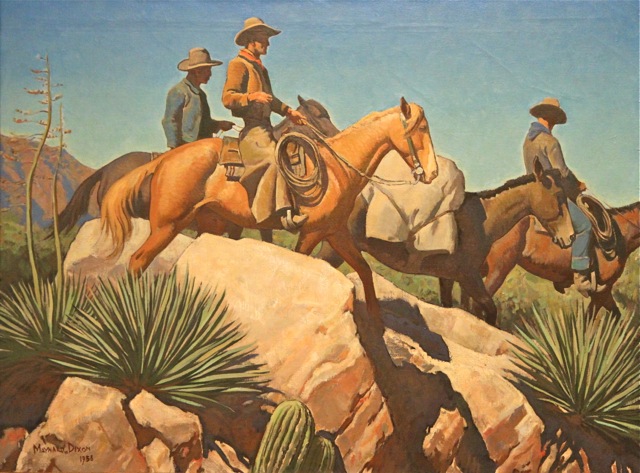
The Cow Country (No Trail), 1938 by
Maynard Dixon (American, 1875-1946)
Dan's photo
The Twins, 1922 by E. Martin Hennings (American, 1886-1956)
Dan's photo
The Dry Ditch, 1964 by
Kenneth Adams (American, 1897-1966)
Dan's photo

From the Eiteljorg we drove out to a big park where the Indianapolis Museum of Art is located. IMA has many features that have special appeal for me, and I really enjoyed the afternoon. The museum's symbol of welcome is a fountain with a fresh modern design.


The Sutphin Fountain
A large new wing has been added since our last trip. It is dramatic and inviting but it blends seamlessly with their original building, which also has modern styling.


Indianapolis Museum of Art
The foyer was used for a wonderful exhibit by an artist named Allyson Shotz; I remembered her name from exhibits at the museum of modern art in New York and SF. She works primarily with images of strings of bubbles, or bubble-like shapes; she expresses streaming bubbles in various media. One was a huge installation of Fresnel lenses strung like beads in garlands hanging across the foyer. Above and behind it were huge photos of streaming bubbles in various patterns. Around the corner were animations (movies) showing bubble-like shapes streaming in hypnotic patterns. What a lot of fun!

Geometry of Light, 2011, by Allyson Shotz, born 1964
Cut plastic Fresnel lens sheets, silvered glass beads, stainless steel wire
Jan's photo


The main galleries are on the second floor. The foyer has a light installation by Robert Irwin that is one of his best works of art. It consists of a pattern of fluorescent tubes adorning the enclosure of an escalator.

Light and Space III, 2008 by
Robert Irwin (American, born 1928)
Dan's photo
Just inside the first exhibit area is an excellent wall drawing by Sol LeWitt, one of my favorite artists.

Wall Drawing No. 652, 1990 by Sol LeWitt (American, 1928-2007)
Dan's photo

Indianapolis gives especially good recognition to women artists. They are lucky to have a rare portrait of a gentleman by Elizabeth Vigée-LeBrun, who usually painted romantic portraits of women.

The Prince of Nassau, 1776 by
Elizabeth Louise Vigée-LeBrun (French, 1755-1842)
Dan's photo
They also have Georgia O'Keeffe's largest and most ambitious floral painting. It was commissioned in 1936 by Elizabeth Arden for the exercise room of her New York Spa.

Jimson Weed, 1937 by Georgia O'Keeffe (American, 1887-1996)
 Dan's Photo
Here's a woman artist I hadn't heard of before. Isn't this excellent? Both stylish and moving. Bobbs was a successful portrait painter in Indianapolis.

Woman in White, 1911, by Ruth Pratt Bobbs , 1884-1973
 Jan's Photo
 It is always special to run across a work by Isabel Bishop.

Tidying Up, 1941 by
Isabel Bishop (American, 1902-1988)
Dan's photo
They have a wonderful collection of Pointillism and Neo-Impressionism; it is considered one of the most comprehensive in the U.S.

The Seashore, c. 1905 by Jean Metzinger (French, 1883-1956)
Dan's photo
Entrance to the Port of Honfleur, 1899 by Paul Signac (French, 1863-1935)
Jan's photo
It is very difficult for American museums to acquire early European masterpieces. IMA has some good examples.

Central Panel of Triptych of the Annunciation, c. 1483
by the Master of the Legend of St. Ursula (Flemish, active 1470-1490)
Dan's photo
Still Life with a Stoneware Jug, Berkemeyer and Smoking Utensils, 1640
 by Pieter Claesz (Dutch, c. 1597-1660), Dan's photo
The museum also has a good collection of American classics.

Whaler and Fishing Vessels near the Coast of Labrador, c. 1880 by
William Bradford (American, 1823-1892)
Dan's photo
Washington Street, Indianapolis at Dusk, 1892-95 by
Theodore Groll (American, 1857-1913)
Dan's photo
The Love Song, 1926 by Norman Rockwell (American, 1894-1978)
Dan's photo
Hauptmann Must Die, 1935 by Reginald Marsh (American, 1898-1954)
Dan's photo
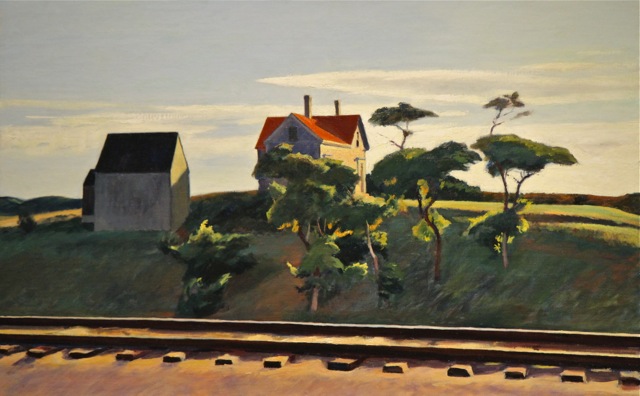
New York, New Haven and Hartford, 1931
 by Edward Hopper (American, 1842-1967), Dan's photo
There was so much to enjoy at IMA that we were glad that the museum was open late. We didn't get there until 1:30, and we had to have some lunch first. We took another break later in the afternoon.

Jan in IMA snack bar; Dan's photo
We finally left after 7 p.m., barely able to walk.

We came back to our hotel and had a hamburger, no bun, in their café. The wait staff was friendly.