Thursday, March 28, 2013

Women Sculptors in American Museums

For a woman artist, it is even more daring to become a sculptor than a painter, and although there were famous women painters as early as the mid-1500s, it is rare to see a sculpture by a woman that was made before the 1800s. As we travel around the country, I make a point to collect images of sculptures by women. I took all the photos in this post during our 2012 art journey.

Among the first notable American sculptors is Emma Stebbins, 1815-1882. She was raised in a wealthy New York family and encouraged to study art from an early age. During the 1800s there was a sort of fad for American sculptors to study in Rome and Emma was part of that. In Rome she was able to pursue a bohemian and lesbian lifestyle that would have been less tolerated at home. What I like about her is that she depicted idealized working men, as opposed to mythical figures.


Industry by Emma Stebbins
Commerce by Emma Stebbins
Another member of Stebbins' circle in Rome, Harriet Hosmer, made sculptures of mythical figures, which are more typical for the 19th century.

Zenobia in Chains, c. 1859
St. Louis Museum (2010 photo)

One of the most popular women sculptors in American museums is Anna Hyatt Huntington. Although she could do excellent mythical figures, she is more well known for her naturalistic depictions of animals. Anna was encouraged to develop her artistic talent by her father, a well-known professor of paleontology and zoology. Anna was at the peak of a successful career in 1923 when she married Archer Milton Huntington, heir to a railway fortune, scholar of Spanish literature, and philanthropist. She continued her career and he built special venues for her work.

Reaching Jaguar, by Anna Hyatt Huntington, 1876-1973
Metropolitan Museum, New York
The woman who has done the most exciting treatment of the female form is Harriet Whitney Frishmuth, who generally worked in bronze. She has the distinction of having studied with Auguste Rodin in Paris. Her slender figures are typically stretching toward the sky.

The Bubble, 1928 by Harriet Whitney Frishmuth, 1880-1980
Crystal Bridges Museum, Bentonville, AR

In the 20th century, women sculptors virtually abandoned the figure and made mostly big bold abstract works. Louise Nevelson may be considered an early re-cycler as her sculptures are typically formed of scraps of wood from a lumber yard. She unified and dignified them by painting them a single color, usually all black, but sometimes all white.

Night Zag Wall, 1974 by Louise Nevelson, 1899-1988
Crystal Bridges Museum, Bentonville, AR

The most respected of British women sculptors is Barbara Hepworth, who is generally over-shadowed by her male contemporary Henry Moore. I really like her smooth, simple forms.
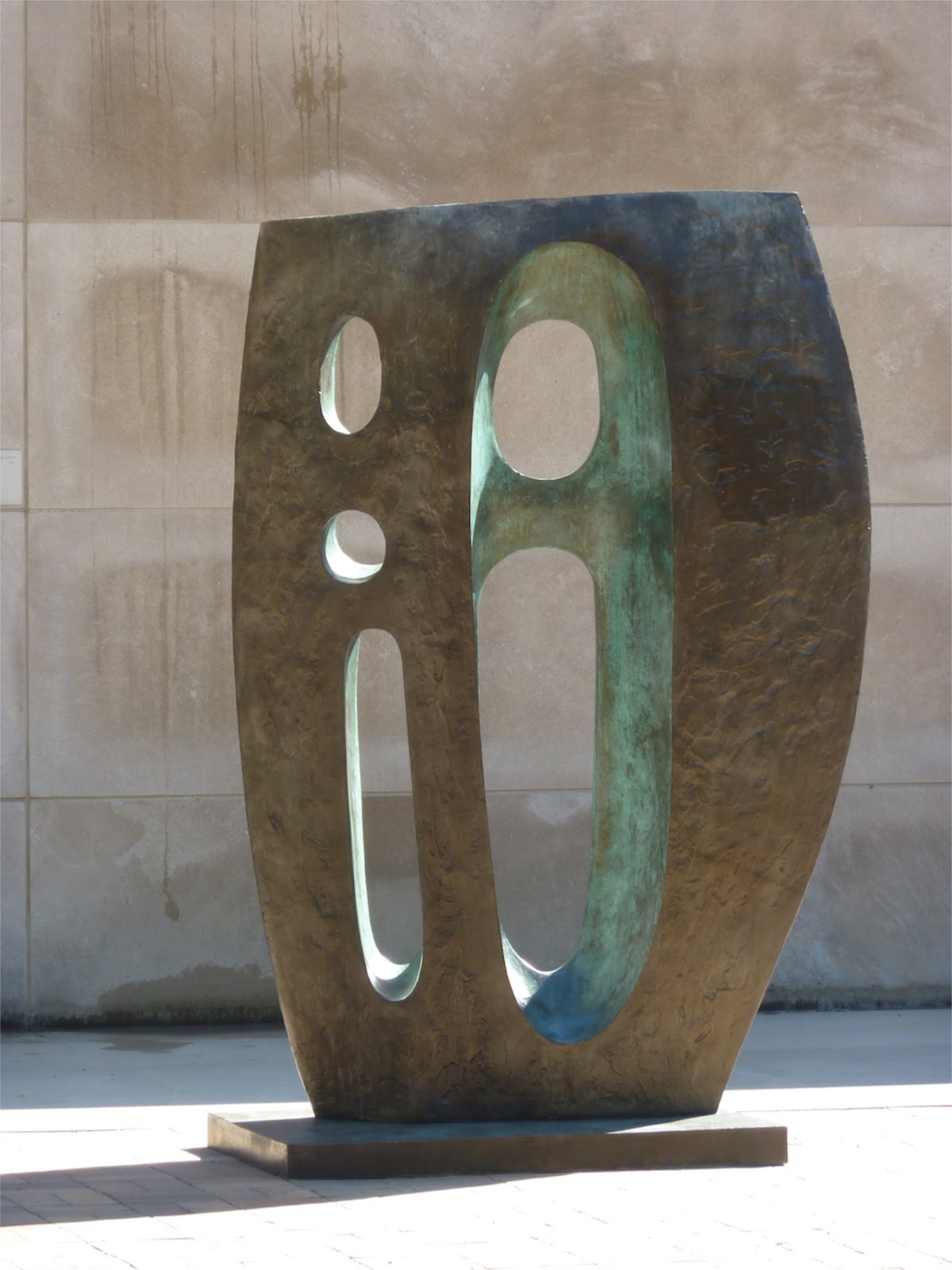
Sea Form (Atlantic), 1964 by Barbara Hepworth, 1903-1975
Dallas Museum
One of the most innovative American sculptors of the 20th century was Louise Bourgeois. Instead of working within one basic style like the other sculptors we've considered, she was constantly experimenting with new forms and materials. In the 1950s she was making vertical forms from painted wood and giving them scientific-sounding titles.

Quarantania I, 1953 by Louise Bourgeois, 1911-2010
Museum of Modern Art, NY
To her great credit, she continued to innovate into her nineties. In 2001 she designed a work to serve as a gateway to the Williams College Museum of Art that consists of a series of sculptures on a landscaped hill. The sculptures are eye-like forms with benches for seating on their back sides.

Eyes, 2001 by Louise Bourgeois, 1911-2010
Williams College Museum, MA
A big favorite in California is Ruth Asawa, who is still living. Born in southern California to a Japanese family, she has been a renowned artist and educator in San Francisco for several decades. Although she first achieved major recognition for her public fountains in San Francisco, most of her astonishing work is done in wire.

Untitled, c. 1970 by Ruth Asawa, b. 1926
Crystal Bridges Museum, Bentonville, AR

What is an American name? At Crystal Bridges Museum of American Art in Arkansas, a visitor puzzling over a large, macho-looking, wall-mounted wood sculpture exclaimed, "Ursula von Rydingsvard is not at American name." What is typically feminine? She went on, "Surely a woman didn't make that! It looks like it was hacked out with a chain saw!"


Unraveling, 2007 by Ursula von Rydingsvard, b. 1942
Crystal Bridges Museum, Bentonville, AR

Crystal Bridges gives very good coverage to women sculptors; I took several of these photos there.

One of my favorite contemporary sculptures was made by Liz Larner, who was born in 1960. I've only seen this one work by Larner, but from the internet I see that she is from California, and she works with a wild variety of forms and materials.

2001, 2001 by Liz Larner, b. 1960
Albright-Knox Museum, Buffalo, NY

In the last few decades, artists are less likely to create free-standing, single forms, and more likely to produce installations with multiple pieces. Artists don't stick with one material, and they don't necessarily fabricate the project with their own hands. A major breakthrough for artists in general was to realize that the idea or vision is the main dynamic in any work of art. The idea may be so large or so complex that a team of specialists is required to realize it, or the material may require some industrial process.

Although she is generally considered a painter, multi-talented Judy Chicago was a major pioneer of installation art with a work on women's history that she created in the 1970's called The Dinner Party. Chicago's idea was that women have been generally left out of "his-story": they don't get a place at the table. So she imagined a triangular table for thirty-nine of the most important women in history, thirteen on a side. Each woman was represented by a placemat embroidered with symbols and a plate formed in a symbolic shape. To bring this idea to reality she assembled a team of women who were already well-known in their crafts; part of her vision was to celebrate women's traditional crafts.

The Dinner Party by Judy Chicago
Photo by Dan L. Smith

Detail of The Dinner Party
Photo by Dan L. Smith

My favorite installation artist is Allyson Shotz. She is pre-occupied with fluidity and reflected light. She might express that in any medium, and her work requires a team of software guys and another team of installers. I have seen three magical installations now that use different arrangements of fresnel lenses to play with the ambient light. However, a major show of Shotz's work that we saw in Indianapolis on our 2012 journey included giant photos of computer-generated bubbles streaming through space plus a couple of mesmerizing animated movies.

Allyson Shotz
Indianapolis Museum of Art
If you would like to see more photos of sculptures by women in American art museums, you can go to my website. 


Saturday, March 9, 2013

Philadelphia Addendum

Our posts on Philadelphia cover the art museums pretty well, but they omit certain important aspects of my experience there.

The city of Philadelphia does a lot to encourage the arts. While we were there, I was fascinated by a public art project called "Open Air." I did mention that the first night we were there, as I closed the drapes I noticed a great number of searchlights playing across the sky. Was a giant used car dealer having a grand opening? I tried to photograph it, but a light rain streaked the window of our motel room. I went to bed puzzled. This light show went on every night that we were there; the weather being mild, I went outside every night to watch it and try to photograph it. I didn't report all this, because neither my photos or video capture the project's high-energy beauty.

Later research revealed the project's background. Designed by Rafael Lozano-Hemmer, "Open Air" consisted of 24 robotic searchlights situated on a half-mile stretch of Benjamin Franklin Parkway, the boulevard in front of our motel. Here's the weird part. The movements, as well as the brightness, of the searchlights is controlled by audio messages from the general public, submitted online or through a free application on iPhone—messages such as "Happy Birthday, Joanie," "Please marry me," and rappers laying down rhymes. The application allowed listening to the message while watching the matching light show, which I didn't try. I grabbed a photo from The Huffington Post to give you an idea of the visual effect.

Open Air by Rafael Lozano-Hemmer
Philadelphia 2012; Internet grab
Our motel in Philadelphia, the Best Western Center City, must have been a premium property at one time. Not only does it have an excellent location in the arts district (with lots of free parking), but also an interesting y-shaped layout that is both unusual and efficient. However, it is getting a little run-down; the main problem during our stay was that one elevator was broken the whole time, leaving only one elevator for a very large motel, and it made clunking noises when it stopped, causing the Japanese tourists to titter and point with alarm.

The motel's least-expected feature was that the doors were totally locked at 10 p.m. and not opened again until 6 a.m., something I've never seen though I've stayed in hundreds of motels. I discovered this by unlucky accident. One morning about 5:15, I went outside to put something in the car. When I tried to return to our room, the motel was locked, every entrance; the key-card readers were non-functional. I thought surely there would be security at the front desk or somewhere; all I found was a hand-scrawled notice that the motel was locked at those hours, and to ring for assistance. The buzzer didn't make a noise. I banged on the front door for awhile, but there was no response.

What a funny situation. No phone. No iPad. Not even a bench to sit on. At least the temperature was mild. To pass the time, I went over to the large convenience store on the corner, which is open 24 hours a day; a police station is just down the block, and several officers, both uniformed and plain clothes, came in while I was there. I trolled the aisles for awhile, then bought a Diet Coke from the fountain and went back to the entrance of the hotel. At 6:05, a sleepy guard trudged to the door and opened the bolt without a word. I made a few excited comments about being locked out; he just trudged to the other door without a response. Oh well, a harmless little adventure.

The motel restaurant served a pretty good breakfast, modestly priced, and Dan ate there every morning. There was a Starbucks just a few blocks away, and I would go there for latte and a yogurt-fruit cup. I really enjoyed these morning walks, past the convenience store, the police station, and the Barnes Foundation, though the sky was generally gray. The amount and variety of activity in those few blocks was very intriguing to me. The last morning I pushed a little farther in order to see a mural a few blocks away. I thought it was lovely and made this photo on my iPod Touch.

Secret Book by Josh Sarantitis, 1999
Touch photo by Jan

I really like Philadelphia, and I especially like staying in a busy part of town.


Sunday, December 23, 2012

Day 55/60: Dallas Museums

My impression after one day of touring in Dallas is that it is an architecture-happy town, and that it has grown at a phenomenal pace in the decade since our previous visit. There are several more skyscrapers downtown with innovative profiles and materials, and several arts-type buildings by big-name architects. In one day, within walking distance of each other in the Cultural District, we photographed buildings by I.M. Pei, Norman Foster, and Renzo Piano.

We parked at the Dallas Museum of Art but we started by walking to the Myerson Symphony Center, which was designed by Io Ming Pei—his actual name is not that hard—pronounced 'Yo Ming.' Anyway, the building had elegant curves. Then we hiked around the corner to see a first rate, and huge, sculpture by Mark DiSuvero, located on a rise where traffic on a busy highway passes it. This put us in an awkward position behind a huge events center, meaning we had some extra walking. It was about 80 degrees at 11:00. Part of the events center is the Winspear Opera House, by Norman Foster and Partners. We enjoyed the reflecting pools and bold lines of the building. Then we had to hike back to the museum. We were steamy and gritty by the time we arrived.

We took a break in the museum's snack bar. I had an iced latte and fresh out of the oven ("not even wrapped yet") chocolate chip cookies. Dan cleverly drank iced water.

I am happy to say that Dallas has improved their collection quite a bit since we were here. Their American collection and their contemporary collection are pretty good; European work, both the old masters and the 20th C. masters, is spotty, but does include some good ones. Their sculpture garden has a small but tasteful collection of modern works.

Dan and I worked separately and very intensely all day. We had salads for lunch in the museum's café. Then Dan wanted to go over to the Nasher Sculpture Center about 2:00 to get good light on the outdoor sculpture. 'I said no way am I going out with the sun so high. I'll go about 4:00.'

The Nasher is just across the street from the art museum; you can buy a joint ticket. It turns out there are lots of trees in the garden creating a much appreciated island of shade. It was about 88 degrees when I got there. The garden has all the big-name sculptors: di Suvero, Barbara Hepworth, Richard Serra, de Kooning—a dozen or so pieces.

The garden at the Nasher is part of an architectural scandal here in Dallas. In response to the development of the Cultural District, some developer built a sky-scraper, but really high, called Museum Tower, nearby. The problem is the same one I brought up in Oklahoma City: too much glass. In this case, sun reflecting off the west side of the building raises the temperature of the garden 20 degrees above its surroundings. The woman who explained it to me said, "So if it's a hundred degrees, it's 120 degrees in here." Oh dear. Just that morning she had read in the newspaper that they had decided to add a louvered screen on the west side that can adjust with the sun. It will only cost $6 million. They should get that money back from the architect, because he should have been able to anticipate this problem; that's what architects are hired for.

The museum building of the Nasher is one of Renzo Piano's best works. The lines are simple and elegant. The light is lovely. The building is even less intrusive than his usual work.

Our Hilton Garden Inn is located right by a busy off-ramp/on-ramp of a freeway. It is quite hard to even get into the parking lot. Driving somewhere for dinner seemed out of the question, as was walking. So we were forced to eat in the wholly uninspiring café at the hotel. I was interested to see how Dan took control of the situation; we were the only customers. He took the table closest to the TV and demanded the remote so he could choose his news commentator; he made them turn off the loud music. The menu was limited and unappealing; deep-fried and over-sized. Dan made the waitress get the cook to negotiate a meal: a hamburger patty with a double helping of mixed veggies. The cook made a nice job of it. It was a lot like home.

I feel bad that I didn't mention the Superstorm that hit the North East a few days ago. We have watched the news coverage closely. We had just visited some of those places. Also we have friends in New York City, who are okay. Of course, we are very sad and upset, same as everyone, and worried about the future. Can't help comparing this with the big storm in New Orleans. These coastal places are more vulnerable to the effects of global warming.


Thursday, December 20, 2012

Holiday Photos

Dear Friends,
For several years Dan has created a holiday greeting card featuring a few of his best photos for the year.  He takes pride in careful printing in order to create a keepsake. It's his way of making a contribution to holiday cheer.

This year, he ran into a series of technical obstacles, starting when his printer ceased functioning; in addition, his old iMac is limping like an aging athlete. So he ordered a new iMac and a new printer, but they haven't yet arrived. He plans to create a card to celebrate the new year.

I'm taking advantage of the situation to do something he would never do: to send an online greeting containing photos of ourselves.

As many of you well know, the major event of 2012 for us was a cross-country expedition to view art museums. We covered 8700 miles and toured 42 museums. We enjoyed ourselves immensely.

Another tourist took this shot of us with the Portland Head Lighthouse in Maine.
Dan photographed us in a mirror on the Ticonderoga, a passenger ship that has been preserved
at the Shelburne Museum in Vermont.
The Ticonderoga, a Lake Champlain Steamer, now an exhibit at the Shelburne.
I took this shot of Dan just before he dug into his grilled flounder with sweet potato fries at Claudio's, a traditional fish restaurant in Greenport, New York. We were in the midst of taking three ferries to get from Stony Brook, NY, to
Groton, CT. This day was a highlight of the trip for Dan.
A major goal of the trip for me was to see a retrospective of wall designs by Sol LeWitt at the Massachussetts Museum of Contemporary Art, MASS MOCA, in North Adams. This was a thrilling day for me.
Here are a couple more shots I took of Dan.
Dan is standing in front of a huge old tree on the property of the Pollock-Krasner House in Springs, NY, which is way out on the tip of Long Island. It was a beautiful location with a peaceful atmosphere. Jackson Pollock and Lee Krasner were important abstract expressionist painters.

Dan is at the Farnesworth Museum in Rockland, ME.
Just to balance things out, here are a couple of self-portraits.

This big mirror was part of an exhibit at the Dallas Museum of Art.
This motel room was in Columbus, OH.
I hope that 2013 is full of fun and excitement for you, in addition to health and prosperity.

Happy Holidays

Joy to the World

Peace on Earth

Good Will to All

Love,
Jan and Dan


Friday, November 9, 2012

Day 61: Barstow to Sunnyvale

We left Barstow at 8:00, very early for us. We arrived home at 4:15, the longest driving day of the trip. There was a cold wind the whole day, and light rain for a short while. We saw wind-turbines fringing the mountains around Tehachapi. On I-5 we observed that agriculture in California is even more intense and diverse than other states, but quite a lot of cropland in the central valley has been abandoned because of water restrictions; signs posted by farmers along the road protest the "Congress-created Dust Bowl." We discussed the competing needs of agriculture and wild Pacific salmon.

Everything is fine at our house. One of our dear neighbors has moved, but the "anchor" of the neighborhood, who knows all the news, happened to be out for his walk and he greeted us.

We have a tremendous sense of accomplishment. We covered 8,700 miles and visited 39 museums. Of 60 nights in motels, Dan negotiated 8 freebees. We saw three national memorials: Flight 93 Memorial in Pennsylvania, 9/11 Memorial in Manhattan, and the Oklahoma City National Memorial. We had pleasant visits with 5 friends.

Dan did almost all the driving. Twice drowsiness forced him to let me drive for an hour. Nothing wakes Dan up like my driving. (It's not like I get a lot of practice.) His driving was virtually flawless, rarely frightening me. The only accident we saw was a big rig on its side across the highway; no emergency vehicles, the big excitement was over. Tow trucks were working on getting the truck upright. In our travels we have twice seen those big trucks turned over on the opposite side of the road. Trucks are the big danger on the road: there are so many of them and they are so competitive; the drivers are pushing themselves and liable to make a mis-step. It's scary to be on an old-fashioned two-way road with no divider. Highway construction was extensive all around the nation; this is good.

It's shocking how divided the nation is. In this last election Colorado legalized the recreational use of marijuana; while we were in Oklahoma, an 'open-carry' law went into effect enabling registered gun owners to carry their weapon openly. In Texas we drove through town after town with no activity or prominent institution except a church; and as we were driving on Sunday, the parking lots were all full.

We saw a phenomenal amount of poverty. Along the state routes you see people living in very remote places in shacks and single-wide motor homes and combinations of the two, surrounded by decades of detritus. Small towns that look largely abandoned. That's another big division in this country: poverty vs. luxury. We felt very lucky to be skimming by it all in our climate-controlled chariot.

All during this trip we enjoyed the largesse of rich people. We saw many museums that were originally founded by individual art collectors who wanted to share their collections; we benefitted from their spirit of philanthropy.

Dan loves the new mini-van. It gave him all the support he needed and enhanced the trip a lot. There is almost too much space; our stuff sort of sloshed around in a semi-organized fashion. We were able to take clothes for all the weather changes and to bring back whatever we wanted.

This is the fourth time we have traveled coast to coast looking at art museums. This was the most successful trip. We had a very detailed plan and stuck to it. We had to skip one museum when we both had a cold, but we crammed in a few places that weren't on the plan.

We got healthier and stronger on the trip. We did not come home all broken down and worn out. In fact, Dan didn't pause for breath after we got home before he went to the Post Office and Safeway.

The next phase of the trip is to process the data we gathered, meaning we have to edit our photos and figure out how we want to share them. It's going to be a busy winter.

Wednesday, November 7, 2012

Day 60/60: Flagstaff to Barstow

It's difficult to work out the timing between Amarillo and Sunnyvale. The way the cities are spaced, you can do 3 long days or 4 short days. Since long days of driving are dangerous, especially when you are driving into the late afternoon sun, we opted for 4 short days.

The scenery between Flagstaff and Barstow is pretty. Nice healthy pine forest leaving Flagstaff. One mountain range after another.

We had lunch at Denny's in Needles; an acceptable chicken salad. Needles is a pretty small town without much going for it.

We stayed at a number of Comfort Suite hotels (toward the high end of the Choice hotel chain) on the trip, enough to get the last two nights of the trip free, based on points. Last night we had a truly crummy Quality Inn (toward the low end of the Choice hotel chain; reminded me of how we used to travel), but tonight's Quality Inn is pretty nice: more spacious, fresher and more functional, with a swinging bar and Mexican restaurant.

It was 29 degrees in Flagstaff when we awoke; it was 89 degrees in Barstow when we arrived.

You may notice that this was the 60th of 60 days and still we're not home. Actually it was 60 nights in motels, and 61 days on the road. Home tomorrow. We were not especially in a hurry to get home, until Amarillo. This last few days with all driving and few distractions makes us impatient.


Tuesday, November 6, 2012

Day 59/60: Albuquerque to Flagstaff

Dan hadn't taken any photos for a couple of days, so he decided we should start the day by shooting the sculpture garden surrounding the Albuquerque Museum of Art. They have a few things by semi-important contemporary artists, and many cowboy and Indian type works by regional artists. The sky was clear and the temperature was slightly chilly, quite nice. Why didn't we tour the museum? We have visited the Albuquerque Museum a couple times in the past; they don't allow photos; they weren't open today.

It was about 9:30 when we got under way. The land in New Mexico is picturesque—mesas, buttes, and reefs of red rock near and far—but it appears to be virtually useless. Almost no agriculture, no mining, no drilling, hardly any railroads along I-40; just tourist stops and souvenirs. We stopped for pictures of the Paloma pueblo, which isn't very picturesque; more shacks than adobes, more vacant than occupied.

We stopped for lunch at our favorite place in Gallup—Don Diego's. This is a large and bustling place, serving both New Mexican and American food. It has become more upscale over the years and recently got a tasteful makeover in which they eliminated all their Mexican bric-a-brac and bright colors and replaced it with beige furniture and framed photos of Native Americans in their daily lives, and native dress. Nevertheless, everyone associated with the restaurant looks to be of Mexican descent, including most of the customers, and the food is authentic New Mexican style, which both Dan and I are partial to. We had the pork carnitas; it was terrific. I bought a turquoise bracelet from one of the constant succession of Native American vendors. He claimed that he and his family made jewelry together, but it was stamped 'Mex.' I can't really say why I went for it.

We stopped again in Winslow, Arizona to investigate a hotel called La Posada. A friend of Dan's had stayed there and had a room with a balcony over-looking the railroad tracks; he enjoyed watching the frequent passing trains. I was interested because La Posada was designed by one of the earliest women architects, Mary Coulter (or Colter, I've seen both). She was a contemporary of Frank Lloyd Wright and Julia Morgan, but she was very unassuming in her manner and didn't attract much attention. She was the architect and interior decorator for the Fred Harvey chain of hotels along the Santa Fe railroad. It was she who decided to use or adapt local Southwest styles, featuring local materials and decorative motives. Before her, Harvey was considering a Swiss chalet style for his hotels. So we owe Mary Coulter a lot. La Posada is a pleasant place; not especially impressive. It is a private business and every inch is used to display or sell art, in addition to being a functional hotel; anyway, it has been through so many changes it is hard to know Coulter's aesthetic intentions.

We got into Flagstaff about 4:30. Our room at the Quality Inn is cramped; only one person can move at a time. "But it was free!" Dan keeps saying. Also we could park right by the door. The freeway is hard by us on one side and the railway on the other, and the sound-proofing is not so hot. Dan went to the Outback Steakhouse for dinner; I decided to rest and watch the election returns.

We managed to stay up long enough to see the President declared the winner, but not to see his acceptance speech. No offense to any Republicans in the crowd (actually, I don't think I have any Republican friends), but I am inexpressibly relieved to have the President returned to the White House.


Day 58/60: Amarillo to Albuquerque

By the time Dan gassed up the car and made a reservation for our last night on the road--negotiating a freebie from Choice Hotels based on points--it was 9:30 when we left. The sky was clear and the temp was 51 degrees.

We passed a little more cattle country in Texas, but as we approached New Mexico, the land became pure desert with little vegetation or economic use, beyond the occasional unhappy cow lying in the shade of a billboard. We soon crossed into New Mexico and changed to Mountain time, rolling the clock back again. Keeps me busy changing all the clocks. Red earth. Mesas and reefs. In the high country there were piñon pine and juniper.

The highlight of the day was an excellent meal in Moriarty. Because a satellite with many spokes was perched over it on a tall post, we spontaneously pulled into a restaurant called El Comedor de Anaya. The menu said the restaurant had been a family business for a few generations. Dan ordered brilliantly. Seeing tilapia tacos on the menu, he asked if he could have that without the taco shell; I followed his lead. We got beautifully grilled tilapia with authentic New Mexico style rice and beans, and a little salad and guacamole. It was great. I couldn't quit eating. Finished with sopapilla and honey. A winner of a meal! But it puzzled me because the waitress was 'white' non-Hispanic, and when the cook emerged from the kitchen she also appeared to be non-Hispanic. Could a middle-aged white woman cook authentic New Mexico style? When I inquired, the waitress said the cook was the daughter of the restaurant's founder, and that one of her brother's had been governor of New Mexico for awhile. So the food was good because the cook knew what she was doing, and she cared.

It was only another hour's drive through the Sandia range to Albuquerque. We got in about 2:30. The temperature was nice, low 70s.

Our first room had a so-called Murphy King, meaning the bed could be folded into the wall. Eh? Apparently some people fold the bed and use the room for meetings. The Murphy bed took up too much room when it was down, so we got the desk clerk to give us a regular king, which is much more comfortable.

Dan had dinner with an old friend of his that I've never met for various obscure reasons. Anyway, I didn't need any more food. I stayed in and worked on the blog.

When I was brushing my teeth before bed, I noticed the water was brown, both in the sink and the tub. I called the front desk. The clerk sent a maintenance guy up. He said the city had done something to the pipes that day and the water was running brown in some of the rooms. He and I ran the water for a long time, then he started getting calls from all the rooms with the same complaint. What a nightmare, for him and for us, too.

I ran the water in the sink and tub for over an hour, and flushed the toilet repeatedly. For a long time the water was very dark brown; sickening. When the maintenance guy came back, he said the city had experienced a rain water leak, which they repaired yesterday. I think he was planning to open a main line to drain the brown water. Eventually the water cleared up pretty much, but when the tub and sink drained completely, I saw they were black with filth. Oooo, yuck. What to do. I couldn't clean it with hand soap and a wash rag. I called the front desk twice asking for cleaning products. I got different answers but no action. Finally I got dressed and went to the front desk, begging for cleaning products. I really didn't think I could sleep with that filth in the bathtub; like a boogie man. For some reason there was still a housekeeper there at 9:45 and they got her to come up and clean up the mess. So I could relax finally and have a sleep. Dan, by the way, slept through the whole crisis.

Monday, November 5, 2012

Day 56/60: Forth Worth Museums

For the final art day of our journey we pulled a triple-header: 3 art museums in one day, bringing us to a total of 39. We were able to do that because the 3 museums are located near each other in a sort of cultural park.

Dan is a big fan of the Kimbell Musem, which has one of the biggest collections of European masters in this country; this was our third visit. This time there were a number of frustrations involved. The Kimbell is in one of the greatest buildings in this country, by Louis I. Kahn; his name is not so well-known, but he is considered a model for architectural trends. His thing was simplicity, concrete, and reflecting pools. I recall the serenity created by the pools around the building, and the light patterns they created in the arched porches. Serenity no more. The lovely building has been surrounded by construction, its pools are dry, the Isamu Noguchi sculpture garden is dry and forlorn, all the delicate trees that softened the ferocious Texas heat are gone. Everything is construction debris and promises.

Their big attraction was that they had their permanent collection arranged in the order it was acquired. That means a magnificent standing Boddisattva might be shown next to a work by Mondrian. Is that helpful? No, it is not. Museum directors like to think that making comparisons across periods of history and art forms is going to stimulate our appreciation. Rubbish. Much more revealing to keep things together that were created under similar influences, and are even reacting to each other. Anyway, we buzzed about for an hour and a half, cherry-picking our favorite works.

The Cardsharps by Caravaggio, c. 1595
Dan's photo
The Cheat with the Ace of Clubs by Georges de la Tour, c. 1634
Dan's photo
A panel painting by Michelangelo, which is a rare thing. This is the first known painting by Michelangelo, believed to be painted when he was 12 or 13! It was a copy of a painting by a German artist of the 1400s.
The Torment of St. Anthony by Michelangelo, 1487 or 1488
Jan's photo
We had lunch at the Kimbell. It was a soup and salad buffet. It worked.

Fortunately The Modern Art Museum is right across the street from the Kimbell, marked by a towering sculpture by Richard Serra.

Vortex by Richard Serra, 2002
Dan's photo
The Modern has a great building by Tadao Ando, who was much influenced by Louis I. Kahn. Again we have simplicity, concrete, and reflecting pools, with the addition of some glass walls: it has a cleansing effect on the mind.

Interior reflecting pool at The Modern
Dan's Photo
The frustration was that the whole second floor was closed for installation of some exhibit. We had a cold drink in their soothingly shady restaurant, took a few exterior shots, raced around the first floor, bagging a few photos. They had important works by Anselm Kiefer and Gerhardt Richter. A very cool Martin Puryear.

Book with Wings by Anselm Kiefer, 1992-1994
Dan's photo

Ladder for Booker T. Washington by Martin Puryear, 1996
Dan's photo
Twenty-five Colored Marilyns (detail) by Andy Warhol, 1962
Dan's photo
Then it was time for the Amon Carter. Even though it is only a block or two away, it is uphill through a park and the temperature was in the high 80s. Not wanting to arrive steaming and sweating, we took the car up to their parking lot. Also, we didn't have any time to waste with this aggressive schedule.

Entrance of Amon Carter Museum
Architect: Philip Johnson
Dan's photo
The building for the Amon Carter was designed by one of the deans of American architecture, Philip Johnson. Johnson not only designed many great buildings in his long career, he championed the cause of modern architecture as an art form, and his constant innovations were frequently at the head of trends. He first designed the Amon Carter in 1961 in what was then the International Style, which he pretty much invented, with streamlined Greek type features. This building has beautifully tapered columns forming a front portico. When the building was expanded around 2002, he designed that as well—which is quite unusual. He was in his 90s at the time, and died at the age of 98. The addition flows smoothly from the old building, functions very well, and has class.

The Amon Carter has American art, with a specialty in Remington and Russell. It is one of Dan's favorite museums. They have some real classics, such as Eakins' "Swimming." These are all Dan's photos.

Indian Women Moving (detail) by Charles M. Russell, 1898
The Smoke Signal by Frederic Remington, 1905
Thunderstorm on Narragansett Bay by Martin Johnson Heade,  1868
Swimming by Thomas Eakins, 1885
Crossing the Pasture by Winslow Homer, 1872
White Birch by Georgia O'Keeffe, 1925
The special exhibit was the American art from the Phillips Collection in Washington, D.C., quite a treasure trove. No photos.

It was 85 degrees at 5:15 when we were driving back to Dallas. Thunderheads were gathering in the east; very pretty.

We talked about finding some place more interesting to eat, but we were pretty tired and we have a long day's driving tomorrow, so we ate here at the hotel again. This time we split the turf n surf. Dan had the filet mignon; I had the prawns. The veggies were fresh. It was all okay. We haven't had a special meal in a few days now.

Our Hilton Garden Inn here in Fort Worth definitely takes the prize for speedy elevators and abundant hot water. And Dan got a week-end deal where we paid only $89 per night and got one of the three nights free. It takes some persistence and negotiation to get these hotel deals, but Dan has got what it takes.

Day 57/60: Dallas to Amarillo

Thanks to rolling back the clock to Standard time, we got under way by 8:45. Sky was clear; there was a one-jacket chill. Traffic was light on Sunday morning. We were dumbfounded by the amount of highway or railway construction going on around the already complex freeway system. Dan says the freeway designers in Texas aren't as smart as those in California and the drivers are more aggressive. It took ages to get through Greater Dallas.

When we finally got out of town we were in cattle country. We saw cattle intermittently all day long, some in depressingly dry pasture. They were lowing, "I wanna go to California." In between was cotton, some of that was depressingly sparse. It looked like they were doing dry-land cotton farming, meaning low yield but vast acreage. The other major economic feature was railroads; all day coal trains passing oil tanker trains.

There were nice trees and low hills part of the way, but as you head west, Texas gets flatter and drier. You may have been to Kansas, but you ain't seen flat till you've been to Texas; not a rise for miles in some areas.

The only break we took was a slight detour to the town of Quanah, which raised a lot of questions. Quanah Parker was the last Comanche chief and was undefeated in war with the whites. But he came to see that white civilization was going to win out in the long run, and he adapted, learning to play a role in the white community. I'm assuming he must have lived in that town some time. The reason we took an interest is that rumor has it that my family is connected by marriage with his. I'm curious about this, but not enough to get into genealogical research. We took a photo of the monument to Quanah Parker in front of the court house. The town of Quanah appeared to be virtually a ghost town; it was Sunday afternoon in very churchy country, so it's hard to be sure if all those businesses were really closed.

For me the day was about a rattle. All day long there was a persistent rattle, no matter how I shifted things around or stuffed towels between them. Around 3:00 I realized the suitcases were packed on end so that they rocked against each other and the wall of the car. When I stopped the rattle, it was so wonderful, like not banging your head against the wall any more.

We got into Amarillo about 4:15. Pleasant temperature; low 70s.

We had a pleasant visit with my cousin and her daughter. My cousin has a wonderful house and an attentive daughter living nearby, and her other children are not far away.

Then we had dinner at Taco Joe's, across the parking lot from our hotel. No Mexicans even remotely involved. Dan was happy with his meal. I didn't have any appetite. I tasted his dish; it seemed corporate and overly spicy to me.


Friday, November 2, 2012

Day 54/60: Oklahoma City to Dallas

We got off to a leisurely start today because we had to go to the art museum to pick up some stuff that I had left in a locker the day before, and the museum didn't open until 11:00. This time Dan figured out the proper entrance so that I didn't have to walk so far; I just walked straight to the locker, opened it with the key I was still carrying, and walked out. No one noticed me coming or going.

So it was about 11:45 when we got started. Traffic on the freeway was jammed all the way out of Oklahoma City and through the suburbs due to construction. When we finally got out of town, we were in cattle country. Pretty dry except for one more fertile river canyon. We had about 3 1/2 hours of monotonous driving, with a stop at a Subway somewhere for a salad.

When we crossed into Texas it was 89 degrees, and the wind was high. Hard to believe.

Driving into Dallas was intimidating. There was a monumental construction project going on along both sides of the freeway: some kind of rail system? Anyway, traffic patterns kept changing, signs were hard to read, traffic was congested.

We got to our Hilton Garden Inn about 5:00, maybe later. Dan was dissatisfied with the first room they gave us, mainly because it overlooked the roof and blowers of the kitchen. So we moved to a room on the fifth floor with a view of the swimming pool and other big hotels in the distance. Anyway, it's a nice big functional room.

I've been feeling a little under par for a couple of days, so I went straight to bed. I actually watched a TV show, other than news, for the first time on the trip. Dan had dinner at the hotel café. We got in a good long night's sleep.

Thursday, November 1, 2012

Day 53/60: OK City, Memorial, Museum

Even more frightening than international terrorism, which at least has an ostensible purpose, is homegrown terrorism, which is committed by someone who is just plain crazy, whatever his reasoning. In 1995 a madman named Timothy McVeigh detonated a truck load of explosive in front of the federal building in Oklahoma City, killing 168 people just out of hatred. Dan decided we should visit the memorial to the victims first thing this morning. Clear skies, chilly breeze.

The footprint of the destroyed building and some adjacent buildings has been devoted to a memorial park featuring a long, shallow reflecting pool with a dedicatory façade at either end. Along one side of the pool is a broad lawn with a sculpted chair for each victim; each chair has a glass base with the name of the victim etched in it, a stone seat, and a metal back. It is quite effective, and rather pretty. We hung about there for awhile, but did not visit the museum, which is in a big building next door.

Our big goal for the day was the Oklahoma City Museum of Art. There is so much construction going on around it, it is hard to get a grip on how it looks or how it functions downtown. There are government buildings all around it. We couldn't even find the entrance; it seems you must go through their fancy café.

My strongest impression from the whole day is 'beware of using glass in the design of buildings, especially in hot places like Oklahoma.' The restaurant was a pretty place, with a long narrow shape and a high glass wall; it was so hot and bright in there that I really wanted to bolt, but it was the only source of caffeine available.

The main entrance was an even worse example. The entrance lobby has a 3 or 4 story glass tower. It looks fabulous; hanging in it is one of the tallest works by Dale Chihuly, a 3-story burst of yellow swirling glass.

Sculpture by Dale Chihuly
Atrium by Allen Brown, Architects
Photo by Jan
The problem is that it is so bright in there that the clerks can't read their computer screens, even though they wear visors, and it is 10 to 20 degrees hotter there than elsewhere in the museum. What is it like in the winter? I've seen this problem before. The great I.M. Pei used glass pyramids in some buildings I've seen; those buildings have similar problems. Big glass elements add architectural excitement, and sometimes they work very well; facing north helps; having the glass high enough over the room helps; tinted glass. Renzo Piano always provides lots of overhangs to mitigate the effect of using so much glass. The building has to function well in addition to looking good.

The first big treat of the art museum was a show of early 20th Century American art from the Brooklyn Museum, which we visited a few weeks back, and have visited twice previously. And the big treat of that was a few wonderful paintings by Georgia O'Keeffe that we had never seen; why don't they put them out? They have been showing the same painting by O'Keeffe, of the Brooklyn Bridge, for years, when they had these other fine things.

The second big treat was a very large collection of glass by Dale Chihuly. We asked an information person how it happened that the museum made such a commitment to Chihuly. She said that several years ago they had a big show of his work and it was so popular that the people of Oklahoma City raised the money to buy the works, with some cooperative negotiation on Chihuly's part. Good story.

Their permanent collection is sketchy, mostly American, a little European art. There were a number of good pieces by little known artists.

Contemplation by Doel Reed, ca. 1940
Photo by Jan
I especially appreciated a little show of op art by big names: Vasarely, Anuskiewicz, and Stanczak.

Vega D by Victor Vasarely, 1968
Radiant Red by Richard Anuszkiewicz, 1966
Photo by Jan
Burning Red by Julian Stanczak, 1969
Photo by Jan
We packed it in around 4:30. Ate dinner at the hotel restaurant; it was convenient. While we were eating, I realized that I had failed to get some stuff from a locker at the museum; I still had the locker key in my purse. That means we have to go to the museum again tomorrow before we leave for Dallas, and the museum does not open until 11:00.

On the practical side, this is a good Best Western Plus, and both nights here were free, thanks to Dan's negotiations back in Maine, or somewhere. Dan did a load of wash in the guest laundry before we left this morning.

Wednesday, October 31, 2012

Day 52/60: Bentonville to Oklahoma City

We started the day with a trip to Walmart to stock up on drinks and snacks. The Supercenter in Bentonville is in no way different from any other Walmart. No souvenirs. No bargain price on the catalog for Crystal Bridges.

We got under way about 10:00. I was amazed to notice that almost as soon as we passed from Arkansas to Oklahoma the land got drier, trees smaller, and it grew more arid as we went west. What we saw was basically cattle country.

We got into Tulsa about 12:30, just the right time for lunch at the Gilcrease Museum. The café has a pretty view of the Osage Mountains, and a rather elegant look. Service seemed painfully slow, and everything on the menu seemed peppery. I settled for salmon salad, very dull. Dan had blackened catfish, which he liked well enough.

This was our third visit to the Gilcrease, and every visit has been disappointing. They have a fairly good collection of American art, quite strong in Western art, and they have a pretty big building, big enough to give their collection a fair showing. But they relegate their permanent collection to about 25% of their gallery space and use the rest for other stuff. Like the Eiteljorg, a similar collection of Western Art in Indianapolis, they used a lot of gallery space commercially—the works were all for sale. They had lots of room devoted to children's discovery activities. They have added a lot of Native American art. To add to the frustration, this year they wouldn't allow photography. Luckily, Dan has photographed our favorites twice before.

They have a couple of massive masterpieces, permanently in place; one by Bierstadt and one by Moran. I enjoyed seeing these old favorites again, but now they have iron railings in front of them, marring the view. We spent a couple of hours review the works by Russell, Remington, Leigh, and Shreyvogel, and the Taos artists. It was okay.

Then we sped on to Oklahoma City, arriving about 5:30, plenty tired. We had dinner at the hotel restaurant. It was casual and comfortable.

Day 51/60: Bentonville, Crystal Bridges

Alice Walton, the daughter of Sam Walton, who founded Walmart, has employed her wealth to create a wonderful new museum of American art on a beautiful piece of family-owned land in Northeast Arkansas. The wooded country was so lovely, that I was thankful for the opportunity to be there. We started our day with a walk on the Art Trail. It doesn't have much sculpture of interest yet, but it has a wonderful sky-viewing building by James Turrell, much like the one at the de Young Museum.

The inspiring museum building was designed by Moshe Safdie, who also designed the new wing of the Telfair Museum in Savannah, which we saw in 2010. Like Frank Lloyd Wright's 'Fallingwater,' it is built over a creek, a creek which has been managed to form reflecting pools. Unfortunately, Arkansas has been in a drought so some areas that should have had rippling falls were dry. The complex is composed of four pavilions. I believe the metaphor was an ark, as the pavilions are tapered like boats and their roofs are composed of massive bentwood beams in broad arcs like the hull of a boat, upside down. It is good to have breaks between pavilions where you can enjoy the woods and water through the glass walls, but it adds to the walking involved.

Ms. Walton came into the collecting game rather late, meaning it was hard to get her hands on works by some very important artists. Take Georgia O'Keeffe; her best stuff has long been ensconced in the major museums. Walton compensated by getting a few small but unusual pieces that show something new about her talent. She had only one work by a Californian, but it was a fab piece of a 'supine woman' by Wayne Thiebaud. She also has excellent work by sometimes-neglected artists. She had a knock-out piece by Harriet Frishmuth, a 19th Century sculptor who communicates joy and abandon like no other. She had a couple wonderful figurative sculptures by Alexander Calder's father, also Alexander Calder.

The collection pretty much runs the gamut from Copley to Ursula von Rydingsvaard. There are several masterpieces that we had seen in other big museums.

Admission is free, covered by Walmart, and photography is permitted. The whole endeavor comes from a very generous spirit. Properties abutting the museum have access to trails through the museum's park, and a trail reaches it from downtown. Ms. Walton has long been a promoter of the region—she got the local airport going—and she has tried to integrate the museum into the community, as well as into the site.

The museum was very well-attended, sometimes too crowded; this on a Monday in late October. Most of the patrons were seniors, many quite infirm. Bentonville, seemingly in the middle of nowhere, is actually fairly convenient to St. Louis, Tulsa, and other major cities.  Most patrons seemed to be from the region. They said things like, "Lookee there! Inat weeeird?" Apparently many patrons have never been to an art museum before, because there is a greeter at the door to explain not to get to close to the art work and other courtesies.

One of the pavilions is devoted to a vast eating hall. It has glass walls and projects over a reflecting pool; light patterns ripple across the broad wooden arches. We stood in line 25 minutes to order; the food came out pretty fast. We both had High South Chicken salad, which was excellent roasted chicken mixed with mayonnaise and cranberries, over greens; it was fine. I had a devastating Devil's food cupcake; I don't know how they can make anything that swell in such vast quantities. Dan had a fancy cookie.

We spent most of the time separately, running around trying to cram the whole collection in, taking as many photos as we could. Mostly the lighting was quite good, but a few large pieces had bad reflections. It is notable that in the galleries there is no natural light at all, quite a departure from the usual practice. The artificial light is even and constant, but you do appreciate the breaks between galleries where you get natural light through glass walls. Both of us made a second trip out to see the Turrell sky-viewing building, perhaps a half hour's rapid walk. The upshot was that by 6:00 p.m. I was so tired I could barely move.

Next we went to downtown Bentonville. On the central square is Walton's original Five and Dime store, now a Visitors' Center. It has some old time kids toys and candies for sale up front, then a museum on Walton on Walmart, which had no interest for us.

For dinner we found an Italian place called Tavola Tratorria. Yes, in Bentonville, Arkansas, we found authentic Italian food. The Wedding Soup with turkey meat balls and risotto, a few veggies, had perfect, delicate Italian spicing; so life-giving. It reminds me that the best 'German' food I ever had was in Hot Springs, Arkansas, several years ago; a black cook working to instructions of German chef. We both had the soup with some sort of fancy salad that was fine. Very pleasant place, and nice service.


Sunday, October 28, 2012

Day 50/60: North Little Rock to Bentonville

Rather than face another day of competing with huge trucks on the interstate, Dan came up with a plan to take a state highway through the Ozarks. This was a beautiful drive. The trees are good size and have large leaves, and they carpeted the hills with gorgeous rich color. The road is steep and winding. Hardly a truck to be seen. Very little traffic in fact.

The temperature was very cold, but the sky formed a clear blue background for the colorful scenery.

View from Overlook provided by National Park Service
Dan's photo
We stopped at a viewpoint with a great view of the Buffalo River Canyon, which is covered by colorful trees.
View from parking lot of Gift Shop
Dan's photo
When we tried to stop for lunch at the Cliff House, the only place for miles around, it was packed on a sunny Sunday afternoon. Both locals and tourists saw that this was a special autumn day and leaf-peepers abounded.

So we went onto Jasper, where we ate at the Ozark Café, a huge place, also jammed, but we were able to find a seat and get reasonable service. The best thing I learned on this trip is that when a restaurant offers deep-fried fish, they can generally grill it, if you ask. I had grilled catfish; was it ever light, almost sweet. Dan had chopped steak, which was done right. The wait staff worked very hard. They weren't grim, but they were serious and they were tired. I was amazed how much it pleased a couple of them when I said the food was good.

One of the signs for the Ozark Café, which is twice this long
Dan's photo
One of three large cluttered rooms at the Ozark Café
Dan's photo
We stopped at a viewpoint down near the Buffalo River where we could observe the handsome gray rock formations along one bank. Because of this year's drought, there was almost no canoeing.

National Park Service Sign
Dan's photo
View of Buffalo River from Pruitt's Landing
Dan's photo
Another view from Pruitt's Landing
Dan's photo
View from Pruitt's Landing with highway bridge in Background
Dan's photo
We left at 10:15 in the morning; we arrived in Bentonville at 5:15. It took a couple of hours longer to come through the mountains than to drive the freeway, but we were less tired when we got here because of the stimulation and the beauty of it.

Dan had dinner at Mama Chu's Asian Cuisine. I didn't need any more food. I had a latte and worked on the blog.